

Most affiliate marketers lose money not because their offers are bad, but because they cannot see what is happening after someone clicks. Raw affiliate links are long, ugly, and invisible to your analytics stack. A proper URL shortener for affiliate marketing fixes all three problems at once.
This guide covers how to manage, track, and optimize every affiliate link you publish, including link cloaking, retargeting pixel attachment, geo targeting, and a repeatable framework called the Affiliate Link Stack.
Why Affiliate Marketers Need a Dedicated Link Shortener
A generic short link is better than a raw affiliate URL. A tracked short link is better still. The difference is what happens in the middle: click data, device breakdowns, geographic distribution, and referral sources.
According to Statista, US affiliate marketing spend is projected to reach $15.7 billion by 2024. That is a market where marginal improvements in click-through rates and conversion tracking translate directly into commission increases.
A raw affiliate link tells you nothing on its own. It hands control over to the merchant's tracking system and leaves you blind on your end. A shortened, tracked link keeps you informed: which post sent the click, which device converted, which country drove the most revenue.
An affiliate marketer without click-level data is running a campaign with no feedback loop. You cannot optimize what you cannot measure, and a tracked short link is the first measurement point you own.
What Is Affiliate Link Cloaking and Why Does It Matter?
Affiliate link cloaking means redirecting a clean, branded short URL to your affiliate destination. Instead of sharing example-merchant.com/ref=abc123&utm_source=..., you share something like hiturl.at/best-camera.
Cloaking matters for three reasons. First, clean links get clicked more often: studies by CXL consistently show that branded, readable URLs outperform raw parameter-heavy links on trust and click-through rate. Second, you protect your affiliate ID from being stripped or replaced by coupon browser extensions. Third, you get a layer of analytics between your content and the merchant.
A branded short link also survives platform changes. If the merchant updates their URL structure, you change the destination once in your dashboard and every instance of that link across your site, email list, and social profiles updates automatically.
Link cloaking is not about hiding intent. It is about owning a clean, controllable redirect you can update, measure, and protect at any time.
The Affiliate Link Stack Framework
The Affiliate Link Stack is a four-layer approach to building affiliate links that do more than redirect. Each layer adds a measurable asset.
- Layer 1: The Clean Short Link. Shorten your affiliate URL into a branded, readable slug. Use a custom alias that matches the product or offer, not a random string.
- Layer 2: UTM Parameters. Append UTM tags to the destination URL before shortening. This passes campaign source, medium, and content data into Google Analytics on the merchant side, if the merchant's page supports it. Learn the full method in this guide on tracking link clicks with UTM parameters.
- Layer 3: Retargeting Pixels. Fire a pixel on every click so your ad platforms build audiences from people who showed purchase intent. Anyone who clicked your affiliate link for a product is a warm lead for related offers.
- Layer 4: Geo and Device Targeting. Send mobile visitors to a mobile-optimized landing page. Send visitors from different countries to localized offers or regional affiliate programs. This layer alone can lift effective commission rates significantly.
Each layer is independent. You can implement one or all four. The point is that every affiliate link you publish can carry more intelligence than a raw redirect.
How to Set Up Tracked Affiliate Links with HitURL
Here is the step-by-step process to build a fully tracked affiliate link using HitURL.
- Create your free account at hiturl.at. No credit card required.
- Paste your affiliate URL into the link shortener. Add a custom alias that describes the offer, such as
/canon-r50or/vpn-deal. - Attach your retargeting pixels. In the link settings, add your Facebook Pixel ID, Google Ads tag, LinkedIn Insight tag, or any combination. HitURL fires these on click, before the visitor even lands on the merchant page. Read the full breakdown in this article on firing retargeting pixels through a URL shortener.
- Configure geo targeting. If you run multiple regional programs (for example, Amazon US vs. Amazon UK), set country-based redirect rules so each visitor lands on the right storefront. The geo targeting guide covers every configuration option.
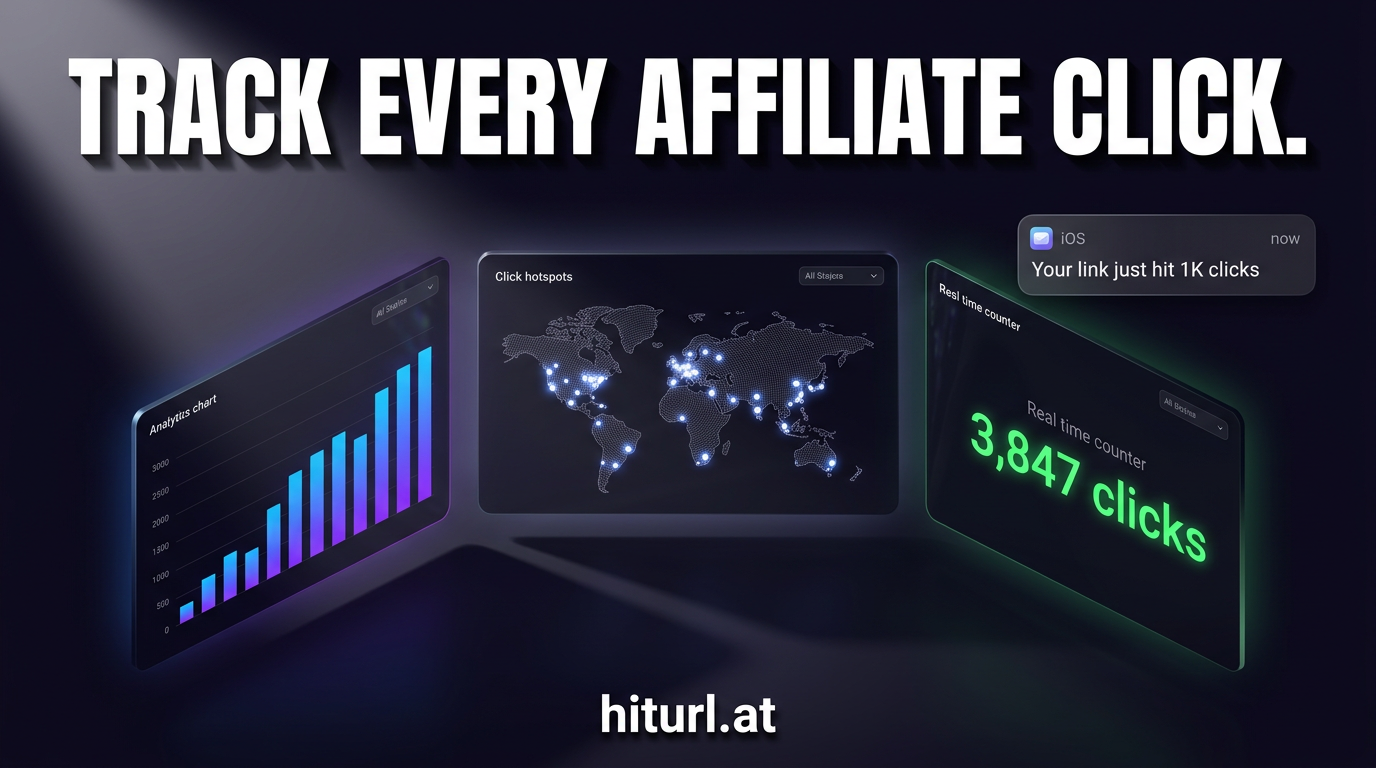
- Publish and monitor. HitURL tracks every click with timestamps, device type, browser, operating system, referrer, and country. You see the data in your dashboard in real time.
The whole setup takes under five minutes for a new link. For high-volume operations, the HitURL REST API lets you create and manage links programmatically. You can find practical API code examples for common affiliate automation scenarios.
See how HitURL tracks every click, fires your pixels, and generates QR codes. Free at hiturl.at. No credit card needed.
Using Retargeting Pixels on Affiliate Links: The Real Advantage
Most affiliate marketers think of retargeting as something only merchants do. That is a missed opportunity.
When you fire your own pixel on a click, you build an audience of people who clicked your affiliate link. That audience showed purchase intent for a specific product. You can now run ads to that audience promoting related products, your own content, or a comparison page that keeps them in your funnel.
Every click on your affiliate link is a signal. Attach a retargeting pixel to that click and you turn a one-time referral into a persistent audience you can market to across Facebook, Google, LinkedIn, and more.
HitURL supports Facebook Pixel, Google Ads, LinkedIn Insight, Twitter Pixel, AdRoll, Quora Pixel, and Google Tag Manager, all attachable to a single short link. You can stack multiple pixels on one link if you run campaigns across several platforms.
A/B Testing Affiliate Offers with Campaign Rotators
Not every affiliate offer converts equally. If you promote two competing VPN services or two camera retailers, you want data on which one performs better with your specific audience. Campaign rotators let you split traffic between destinations and compare conversion rates directly.
The process: create a rotator campaign in HitURL, add both affiliate URLs as destinations, set the traffic split (50/50 to start), and publish one short link. HitURL distributes clicks across the destinations and tracks performance per variant. After a statistically meaningful sample, you shift traffic to the winner.
This approach is especially useful for content affiliates who run the same offer across email and social. You can test not the offer itself but the landing page variation on the merchant side, something most affiliate dashboards do not let you measure at all.
For a deeper look at building affiliate-specific tracking setups for your blog, see the guide on monetizing your blog with short links and affiliate tracking.
Is Affiliate Link Cloaking Allowed by Affiliate Programs?
Yes, in most cases. Most major affiliate networks and programs permit redirecting links through your own domain or a short link service, provided you comply with their disclosure requirements. The FTC requires clear disclosure that a link is an affiliate link, regardless of how it looks.
The nuance: some programs explicitly address link shorteners in their terms. Always check the terms of service for each program before cloaking. The redirect itself is not the concern for most programs; the concern is whether you are obscuring the affiliate relationship from readers, which is a disclosure issue, not a technical one.
Does Amazon Allow URL Shorteners for Affiliate Links?
This is the most common question in affiliate marketing forums, and the answer requires care.
Amazon's Associates Program Operating Agreement explicitly states that you may not cloak, hide, spoof, or otherwise obscure the URL of your site or the Amazon site in a way that makes it impossible for a user to identify it. This means masking the final Amazon destination is a violation of their terms.
What you can do: use a tracked redirect that passes through transparently to the Amazon URL, and disclose the affiliate relationship clearly. The short link can carry your tracking data for your own analytics. What you cannot do is use a redirect that hides the Amazon domain from the browser bar or uses frame-based cloaking that keeps the visitor on your domain visually.
For Amazon Associates, use short links for your own click analytics and audience building, but ensure the final destination is visible and the Amazon domain resolves in the browser. Disclosure is mandatory regardless of link format.
When in doubt, test your redirect in a browser and verify that the Amazon URL appears in the address bar after the click resolves.
FAQ: URL Shorteners and Affiliate Marketing
Does using a URL shortener affect my affiliate tracking?
No. A standard 301 or 302 redirect passes the click through to the merchant's tracking system. Your affiliate ID in the destination URL is preserved. Your own click data is captured at the short link level before the redirect fires.
Can I use HitURL with any affiliate network?
Yes. HitURL shortens any destination URL, including links from Amazon Associates, ShareASale, CJ Affiliate, Impact, PartnerStack, and any other network. You create the short link pointing to your affiliate URL, and the redirect handles the rest.
What is the difference between link cloaking and a regular short link?
A regular short link redirects to the destination and the destination URL appears in the browser. Link cloaking typically uses frame-based or JavaScript methods to keep your domain in the browser bar. Most affiliate programs permit standard redirects but prohibit frame-based cloaking. HitURL creates standard redirect short links.
Do I need a custom domain to track affiliate clicks?
No. HitURL provides tracking on all links, including those on the default hiturl.at domain. A custom domain adds branding and trust, but it is not required to access click analytics, pixel firing, or geo targeting features.
How do I scale affiliate link management across hundreds of products?
Use the HitURL REST API to create and update links programmatically. You can build scripts that generate short links in bulk, attach pixels, and pull click data into your own reporting system. The API code examples guide shows practical implementations for exactly this use case.
Start Tracking Affiliate Clicks Today
Every affiliate link you publish without tracking is a missed data point. Over time, those gaps mean you are optimizing based on commission reports alone, with no visibility into which content, which audience, or which device is actually driving results.
The Affiliate Link Stack gives you a repeatable system: clean short links, UTM parameters, retargeting pixels, and geo-based routing, all from a single dashboard. It takes minutes to set up and the data compounds over time.
See how HitURL tracks every click, fires your pixels, and generates QR codes. Create your free account at hiturl.at. No credit card needed.