

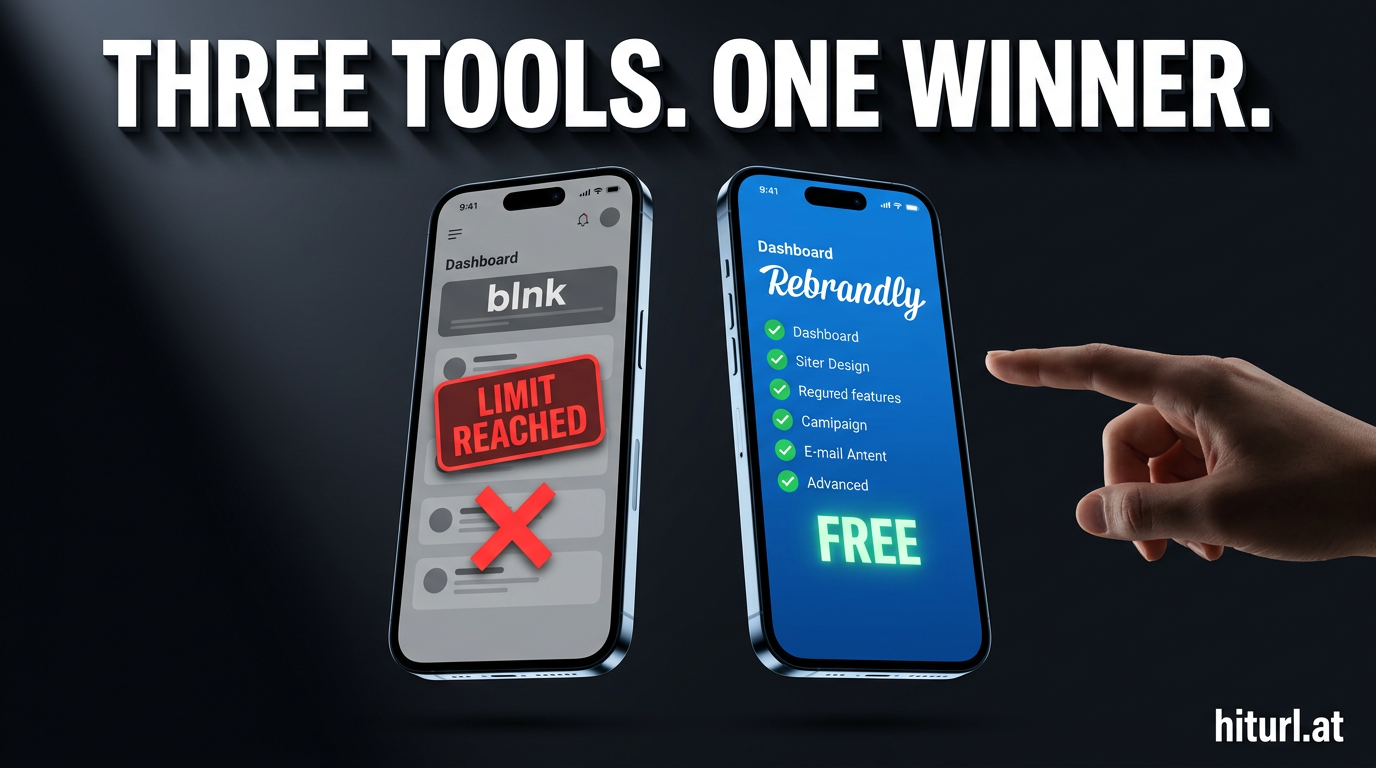
If you are evaluating blnk vs rebrandly for enterprise link infrastructure, you already know the basics of URL shortening are irrelevant. What matters is API reliability under load, how granular your team permission model can get, whether webhooks fire in real time, and what happens to your bill when you generate 500,000 links a month. This article breaks all of that down, and adds HitURL to the comparison so you have a complete picture.
By the end, you will know exactly which platform fits your architecture, your team size, and your budget for 2026.
What Is Blnk, and Who Is It Built For?
Blnk is a developer-first URL shortener that positions itself around programmatic link creation and clean API design. Its core audience is engineering teams that need to generate links at scale inside product flows, not marketers managing campaign dashboards. The interface is minimal by design. The documentation is technical. If you are building a SaaS product that embeds short links into transactional emails or notifications, Blnk is worth evaluating seriously.
Where Blnk has gaps: its analytics layer is thin compared to dedicated marketing-grade platforms, and its team collaboration features are sparse. For a pure developer use case with no marketing oversight needed, that may be fine. For cross-functional enterprise teams, it creates friction.
What Does Rebrandly Enterprise Actually Offer?
Rebrandly has spent years building a credible enterprise tier. Its branded link management includes multi-user workspaces, custom domain support, UTM builder integration, and a moderately deep API. The Rebrandly pricing structure scales by link volume and seat count, which means costs climb quickly for large teams generating links at volume.
Rebrandly's permission model covers roles like Admin, Manager, and Viewer at the workspace level. It does not offer resource-level permissions, so you cannot restrict a user to a specific domain or campaign folder without creating a separate workspace. That is a real limitation for enterprises running multiple brands under one account.
Rebrandly's workspace-level roles work for single-brand teams but break down when an enterprise needs to isolate permissions by domain, campaign, or business unit. Resource-level access control is the missing layer.
How Does HitURL Compare as Enterprise Link Infrastructure?
HitURL sits at the intersection of developer flexibility and marketer usability. It supports custom domains with no arbitrary cap on the free tier entry point, making it accessible for teams that want to test infrastructure before committing budget. The platform covers the full stack: short links with custom aliases, retargeting pixel firing on click (Facebook, Google, LinkedIn, Twitter, AdRoll, Quora, and GTM), geo and device targeting, dynamic QR codes, link-in-bio pages, and a REST API with documented endpoints.
For a detailed breakdown of how HitURL stacks up against another major competitor, the Rebrandly vs HitURL comparison covers pricing, feature parity, and API depth side by side. And if you want the broader market context, the best URL shorteners for 2026 guide ranks the top platforms across all use cases.
HitURL fires retargeting pixels on every click, regardless of which platform the visitor came from. That means a single short link can simultaneously build your Google, Facebook, and LinkedIn retargeting audiences without any extra tagging work.
API Latency and Programmatic Link Generation: A Real Comparison
API latency is where developer teams either trust a platform or abandon it. For high-volume programmatic generation, you need consistent response times under 200ms at the 95th percentile, reliable uptime SLAs, and sensible rate limits that do not throttle production workloads during traffic spikes.
Blnk is built with API-first design, and its link creation endpoint is lightweight. Developers report consistent performance for single-link creation calls, but batch link generation requires sequential requests in most documented patterns, which adds up at scale. There is no published SLA for the free or starter tiers.
Rebrandly's API is mature and well-documented, with bulk creation support on enterprise plans. Response times are generally solid, but the platform enforces rate limits that can surprise teams running large automated jobs. Enterprise contracts include dedicated SLA terms, but those require negotiation and custom pricing.
HitURL's REST API supports programmatic link creation with custom alias assignment, domain targeting, and pixel configuration in a single call. For practical implementation, the URL shortener API code examples page shows real request and response patterns in multiple languages. That is useful for developers evaluating integration effort before committing.
According to Cloudflare's performance research, a 100ms increase in API response time can measurably impact downstream user experience in product flows. For teams embedding short links into real-time workflows, this is not a theoretical concern.
Custom Domain Flexibility: How Many, How Fast, at What Cost?
Custom domains are table stakes for enterprise link infrastructure. The real differentiator is how each platform handles multi-domain environments, DNS propagation speed, and whether domain slots are gated behind paid tiers.
Blnk allows custom domain configuration, but the number of domains available scales with plan tier. Documentation on domain limits per plan is not prominently featured, which means you need to contact sales to understand your ceiling before building around it.
Rebrandly has made custom domains a core selling point. Even on mid-tier plans you get multiple domains, and the enterprise tier removes the cap. The domain setup process is well-documented. The friction point is cost: adding domains at scale on Rebrandly pushes you into higher plan brackets quickly.
HitURL supports custom domains with branded short links and dynamic QR codes. A dynamic QR code, meaning one where the destination URL can be changed after the QR code is printed or distributed, uses your custom domain so every scan reinforces your brand. This matters for print campaigns, packaging, and event materials where the physical asset cannot be reprinted but the destination needs to change.
A dynamic QR code tied to a custom domain gives you the flexibility to update campaign destinations without reprinting physical materials. For retail, events, and packaging use cases, that is a meaningful operational advantage.
Team Permissions and Workspace Architecture for Enterprise Teams
Enterprise link management is not a solo activity. You need a permission model that maps to how your organization actually operates: brand teams that should not be able to touch developer API keys, regional marketers who only see their own campaigns, and admins who can audit everything.
Here is how the three platforms stack up on permission architecture:
- Blnk: Basic role separation. Suitable for small engineering teams. Not designed for complex multi-brand or multi-region structures.
- Rebrandly: Workspace-level roles (Admin, Manager, Viewer). No resource-level permissions. Multiple brands require multiple workspaces and multiple billing accounts.
- HitURL: Team and campaign-level organization with link grouping by campaign. Supports multiple custom domains under one account for multi-brand management without account fragmentation.
For teams that also need to manage paid media retargeting alongside links, HitURL's pixel integration inside the link layer removes the need for a separate tag management layer for basic retargeting workflows. The platform supports GTM alongside native pixel support for the major ad platforms, which matters for teams that want both approaches available.
For a direct feature comparison with another market leader, the Bitly vs HitURL comparison for 2026 covers workspace structure, API access, and pricing tiers in detail.
Switch to HitURL today. Free to start, and you keep every feature that matters. Create your free account at hiturl.at.
Webhook Availability: Does Each Platform Support Real-Time Event Streaming?
Webhooks are the connective tissue between your link infrastructure and the rest of your stack. Real-time click events sent to your data warehouse, CRM, or alerting system separate a serious enterprise tool from a dashboard-only product.
Blnk does not prominently feature webhook support in its public documentation. For developer-native use cases, this is a notable gap. If your architecture depends on event-driven triggers off link clicks, you are looking at polling the API or building your own middleware layer.
Rebrandly supports webhooks on enterprise plans. Click events can be streamed to external endpoints, which enables integration with Segment, Zapier, or custom data pipelines. The catch is that webhook access is not available on lower-tier plans, so teams need to budget for enterprise tier to use this capability.
HitURL's retargeting pixel architecture achieves a similar outcome for ad platform retargeting: every click fires the configured pixels in real time, without any additional webhook configuration. For teams whose primary downstream need is audience building rather than internal data streaming, this covers the use case without added complexity. For teams that need raw click data sent to internal systems, reviewing the API documentation and code examples shows the query options available for pulling click data programmatically.
Cost Scaling for High-Volume Programmatic Link Generation
Cost at scale is where enterprise link infrastructure decisions are actually made. A platform that looks affordable at 10,000 links a month can become a significant line item at 500,000 links.
According to research by Gartner on SaaS pricing models, usage-based pricing tiers are among the top drivers of unexpected cost overruns for enterprise software buyers. Link volume pricing follows this exact pattern.
The comparison table below uses publicly available pricing tiers as of early 2025. Always verify current pricing directly with each vendor before making a budget commitment.
| Platform | Free Tier Links/Month | Custom Domains (Entry) | API Access | Webhooks | Retargeting Pixels | Geo/Device Targeting |
|---|---|---|---|---|---|---|
| Blnk | Limited | Yes (plan-gated) | Yes | Not documented | No | Limited |
| Rebrandly | 500 | 1 domain | Yes | Enterprise only | No | No (native) |
| HitURL | Free to start | Yes | Yes | Pixel-based real-time | Yes (7 platforms) | Yes |
For a full breakdown of what HitURL includes at each tier, the HitURL pricing page lists every feature available by plan with no hidden gating.
When evaluating enterprise link platforms on cost, the real question is not what you pay at launch. It is what you pay when your link volume doubles. Platforms that gate webhooks, domains, and API rate limits behind top-tier plans change the math significantly as you scale.
The Enterprise Link Infrastructure Decision Framework
Use this framework, called the Four-Gate Method, to score each platform against your actual requirements before signing a contract.
- Gate 1: API Fit. Can the API handle your peak programmatic generation volume without throttling? Are batch endpoints available? Is the documentation complete enough for your team to integrate without vendor support?
- Gate 2: Permission Architecture. Does the role model map to your organizational structure? Can you isolate access by brand, region, or campaign without creating separate billing accounts?
- Gate 3: Data Portability. Can you get raw click data out in real time via webhooks, or are you dependent on the platform's own dashboard? Does the export format work with your data stack?
- Gate 4: Cost Ceiling. What does the platform cost at 10x your current volume? Is that number in your budget? Are there overage charges, or does volume gate you to a higher tier automatically?
Blnk passes Gate 1 for pure developer teams but struggles at Gate 2 and Gate 3 for complex organizational structures. Rebrandly passes Gate 1, 2, and 3 but often fails Gate 4 for high-volume teams when enterprise contract pricing is factored in. HitURL passes all four gates for teams whose primary workflows involve branded links, retargeting, geo targeting, and campaign management, and it starts free so Gate 4 risk is low at entry.
FAQ: Blnk vs Rebrandly vs HitURL for Enterprise Teams
Is Blnk suitable for enterprise marketing teams, or only for developers?
Blnk is primarily built for developers and engineering teams generating links programmatically inside product workflows. It lacks the campaign management, analytics depth, and team collaboration features that marketing teams typically require. Enterprise marketing operations teams will find Rebrandly or HitURL a better fit.
Does Rebrandly support retargeting pixels on short links?
Rebrandly does not natively fire retargeting pixels on link clicks. Teams that need to build ad platform audiences from link clicks must implement this through separate tag management or landing page pixel placement. HitURL fires retargeting pixels directly from the short link on every click.
What is the difference between a static and a dynamic QR code in this context?
A static QR code encodes the destination URL directly in the code itself, meaning it cannot be changed after creation. A dynamic QR code, by contrast, points to a short URL that you control, so the destination can be updated at any time without regenerating or reprinting the code. HitURL generates dynamic QR codes tied to your custom domain.
Can HitURL handle API-driven link creation at enterprise volume?
Yes. HitURL's REST API supports programmatic link creation with custom alias assignment, pixel configuration, and geo and device targeting rules in a single request. Review the API documentation and code examples for integration patterns and rate limit details relevant to your volume requirements.
How does Rebrandly's enterprise pricing compare to HitURL at scale?
Rebrandly's enterprise pricing is negotiated and scales with seat count and link volume, which makes it unpredictable for fast-growing teams. HitURL publishes transparent pricing tiers with no hidden gating on core features. For teams in the growth phase, HitURL's cost ceiling is significantly lower for equivalent functionality.
The Bottom Line
Blnk is a solid choice for a small engineering team that needs clean API access and nothing else. Rebrandly is a mature platform that handles branded link management well but prices out many teams at scale and lacks native retargeting capability. HitURL covers the full infrastructure stack: branded links, retargeting pixels, geo and device targeting, dynamic QR codes, team campaign management, and a documented REST API, all starting free.
For enterprise teams that need link infrastructure to do more than redirect traffic, the choice is straightforward.
Switch to HitURL today. Free to start, and you keep every feature that matters. Get started at hiturl.at.